The 4 Freediving Fitness Archetypes: Why Your Training Might Not Be Working
Two freedivers can follow exactly the same training plan, complete the same CO₂ tables and swim similar distances — yet experience completely different results.
One suffers almost immediately but somehow keeps going.
Another feels incredible in training but hits a sudden wall when attempting a PB.
Another feels comfortable until, seemingly out of nowhere, the urge to breathe becomes overwhelming.
And another progresses relatively smoothly without any obvious physiological weakness.
Why?
Because freedivers don't all respond to training and increasing dive intensity in the same way.
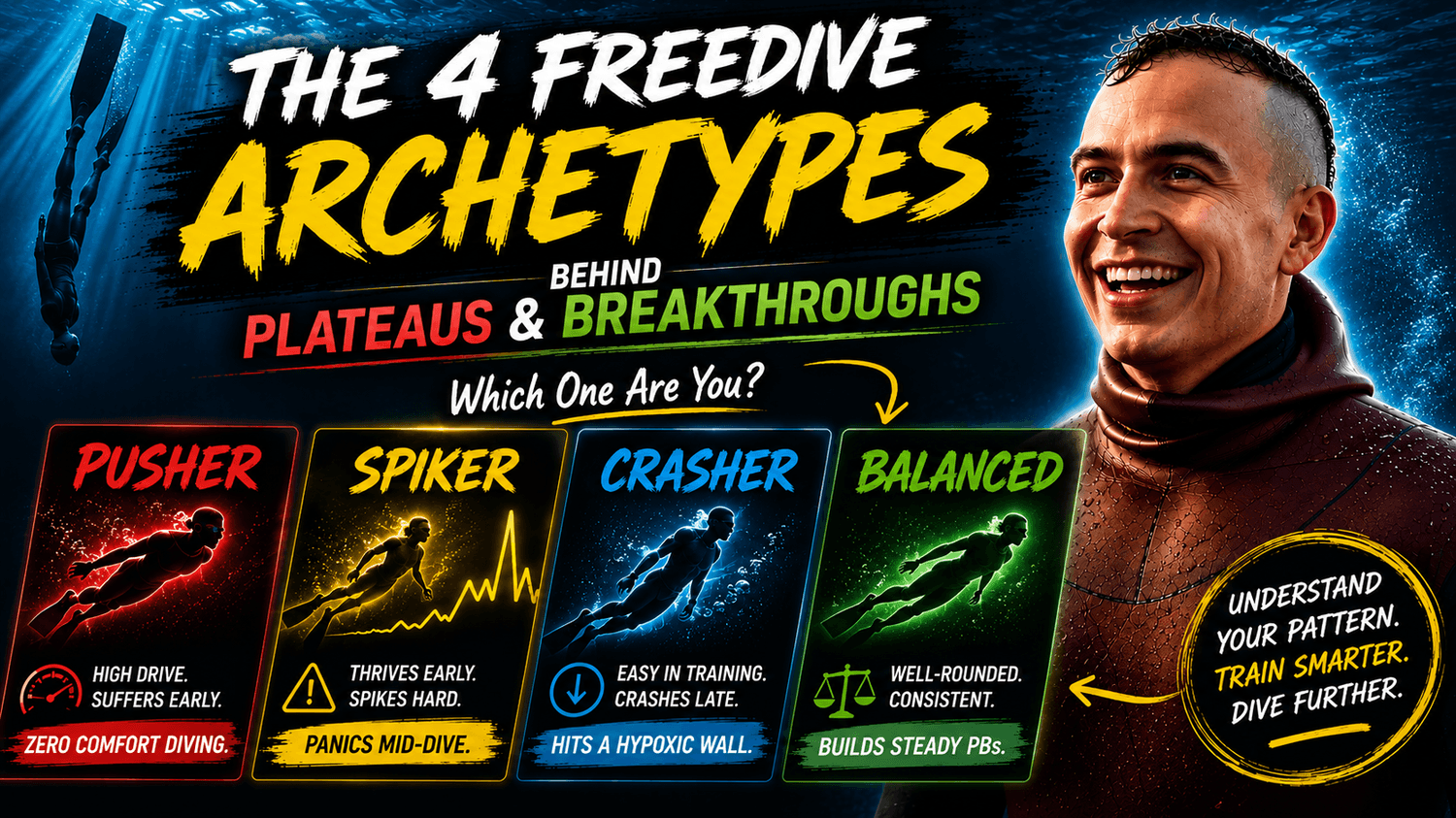
Through analysing how freedivers respond to different training intensities, we've identified four distinct Freediving Fitness Archetypes:
The Pusher
The Spiker
The Crasher
The Balanced Diver
Understanding your archetype can help explain why certain types of freediving training work brilliantly for you while others leave you frustrated, exhausted or stuck at the same level.
More importantly, it can help answer a much more useful question:
What does your body actually need to improve?
What Is a Freediving Fitness Archetype?
Your Freediving Fitness Archetype describes the relationship between your comfort, urge to breathe, physical intensity and maximum performance capacity.
Think about a pool dive progressing through three broad training zones:
Green Zone — Comfort
The dive feels controlled and relatively easy. Urge to breathe and physical stress are low.
Yellow Zone — Sustained Discomfort
CO₂, contractions and physical discomfort become increasingly noticeable, but you can continue working in a controlled way.
Red Zone — High Intensity
You're approaching your upper limits. Hypoxia, muscular fatigue, lactate and psychological effort become increasingly significant.
Ideally, these zones progress in a relatively proportional way.
But they don't always.
One diver might leave their Green Zone extremely early.
Another might have almost no Yellow Zone.
Another can remain comfortable for an extraordinarily long time but lack the capacity to perform once they reach the Red Zone.
Those relationships create very different diving experiences — and very different training needs.
That's where the four archetypes come in.
1. The Pusher: "Why Does Freediving Feel So Hard?"
Pushers tend to experience discomfort much earlier than their actual physical capacity would suggest.
Their urge to breathe can appear early. CO₂ feels intense. Contractions may start sooner than expected.
While other divers still appear relaxed, the Pusher already feels like they're working.
But Pushers have another defining characteristic:
They're incredibly good at continuing despite that discomfort.
They often develop significant mental toughness and the ability to perform while suffering.
A Pusher might therefore complete an impressive dive — but experience considerably more discomfort getting there than another diver with the same PB.
What being a Pusher can feel like
You may recognise yourself as a Pusher if:
Your urge to breathe starts early.
CO₂-heavy training feels disproportionately difficult.
You spend a large percentage of longer dives uncomfortable.
You're mentally very good at forcing yourself to continue.
You often assume the solution is simply to become better at tolerating discomfort.
And that's where Pushers can get trapped.
The Pusher training mistake
If you're already extremely good at pushing through discomfort, more suffering isn't necessarily the adaptation you need.
Constantly performing hard CO₂ tables and high-intensity sessions can reinforce the exact characteristics you're already strong at.
Instead, the goal may be to develop the physiology that allows you to stay comfortable for longer.
The question changes from:
"How do I tolerate more suffering?"
to:
"Why am I suffering so early in the first place?"
2. The Spiker: "Everything Was Fine… Until It Wasn't"
Spikers experience freediving very differently.
The beginning of the dive can feel completely normal.
They're relaxed.
They're comfortable.
Their urge to breathe develops as expected.
Then they cross a threshold.
And suddenly:
4/10 becomes 8/10.
Instead of experiencing a long, progressive Yellow Zone, the Spiker's sensations escalate dramatically.
This can make the middle-to-later stages of longer dives psychologically difficult.
What being a Spiker can feel like
You might recognise this pattern if:
Your dives initially feel controlled and comfortable.
Your urge to breathe suddenly increases rather than building gradually.
The middle of longer dives can feel disproportionately difficult.
You sometimes abort dives because the intensity feels like you've reached your limit.
Once you've crossed a certain point, your sensations can become overwhelming very quickly.
The crucial distinction is that how close you feel to your limit isn't necessarily how close you actually are.
A Spiker may feel like they're operating at maximum capacity when they still have considerably more physiological capacity available.
The Spiker training mistake
The obvious reaction is to train harder.
But if the underlying issue is a poorly developed transition between moderate and high intensity, constantly jumping from easy training into extremely hard efforts may simply reproduce the same problem.
Instead, Spikers often need to develop their ability to remain controlled within sustained moderate discomfort.
In other words:
Build the Yellow Zone.
3. The Crasher: "I'm Great in Training — So Why Can't I Hit My PB?"
Crashers can be extremely impressive in training.
Their easy dives look effortless.
They may repeatedly swim 25m, 50m or even 75m distances with short recoveries while appearing completely relaxed.
Their first contractions can come extremely late.
Their efficiency can be exceptional.
Then it's time for a maximum attempt.
And suddenly everything changes.
What being a Crasher can feel like
Crashers often experience:
A huge comfort zone.
Late contractions.
Excellent performance during repeated sub-maximal dives.
High apparent CO₂ tolerance.
Very efficient easy and moderate-intensity diving.
A dramatic drop in performance when approaching maximum efforts.
Instead of progressively struggling more as intensity increases, the Crasher can remain comfortable for a remarkably long time before encountering a sudden hypoxic or physical wall.
That's why their training numbers can sometimes look disproportionately impressive compared with their PB.
The Crasher training mistake
Because easy and moderate training feels so good, Crashers can accumulate huge amounts of it.
And because they're good at it, that training can reinforce their existing strengths.
But eventually performance requires something different.
The Crasher needs sufficient capacity to continue performing when oxygen is low, lactate is rising and the dive is no longer metabolically easy.
Their question isn't:
"How can I become even more efficient?"
It's:
"Can I perform when efficiency alone is no longer enough?"
4. The Balanced Diver: "Everything Works — So What Should I Train?"
The Balanced Diver has the most proportional relationship between their different physiological thresholds.
Easy training feels easy.
Moderate training feels moderately challenging.
Hard training feels hard.
As recovery times decrease or distances increase, the change in difficulty tends to happen progressively rather than suddenly.
Their Green, Yellow and Red Zones are relatively well developed.
Which sounds perfect.
And physiologically, it often is.
But Balanced divers have a different problem.
What being Balanced can feel like
You may be a Balanced Diver if:
Increasing training intensity produces predictable changes in difficulty.
Your urge to breathe develops progressively.
You can tolerate moderate discomfort without suddenly escalating into panic.
You can perform effectively at high intensity.
There isn't one glaring physiological weakness limiting your diving.
The challenge becomes knowing what to prioritise.
The Balanced Diver training mistake
Without an obvious weakness, it's easy to start chasing one specific adaptation.
More CO₂ tolerance.
More hypoxic training.
More conditioning.
More hard dives.
But excessive emphasis on one area can gradually disrupt the balance that made the diver effective in the first place.
Balanced divers therefore benefit from goal-specific training without abandoning overall physiological balance.
Why Your Freediving Archetype Matters
Freediving training often revolves around individual exercises.
Do more CO₂ tables.
Train O₂ tolerance.
Increase distance.
Reduce recovery.
Do harder dynamics.
But exercises aren't inherently good or bad.
Their value depends on what adaptation you need.
Imagine giving the same training programme to a Pusher and a Crasher.
The Pusher may already have plenty of ability to perform under extreme discomfort but desperately need to improve efficiency and comfort.
The Crasher may already possess incredible efficiency and comfort but lack sufficient high-intensity capacity.
Giving both divers more of the same training doesn't make sense.
Yet this is exactly what happens when freediving programmes are built around generic distances, tables and percentages rather than the individual diver's physiology.
Your Strengths Can Become Your Biggest Training Trap
There's another important principle behind the archetypes:
We tend to train what we're already good at.
Why?
Because it feels good.
If you're excellent at short-recovery repetitions, you'll probably enjoy doing them.
If you're mentally tough, you may gravitate towards brutal sessions.
If you're naturally comfortable underwater, you may accumulate enormous amounts of easy volume.
And because you're good at those sessions, the numbers reinforce the belief that your training is working.
But performance isn't simply about making your strengths stronger.
Sometimes the biggest breakthrough comes from identifying the part of your physiology you've unintentionally avoided developing.
That's why understanding your archetype can be so powerful.
It gives you a framework for asking:
Am I actually training my limitation — or just repeatedly demonstrating my strength?
Which Freediving Archetype Are You?
You may already recognise yourself strongly in one of these descriptions.
But identifying an archetype isn't simply about whether you feel like a Pusher, Spiker or Crasher.
We look at how your performance changes across different intensities, distances and recovery periods to understand the relationships between your different training zones.
That's what our Freedive Fitness Assessment is designed to investigate.
The assessment helps identify:
Your Freediving Fitness Archetype
Are you predominantly a Pusher, Spiker, Crasher or Balanced Diver?
Your individual strengths and weaknesses
Where is your physiology already highly developed — and where could it be limiting your performance?
Your training priorities
Instead of simply doing more freediving training, you can begin targeting the adaptations most relevant to your diving.
→ [Take the Freedive Fitness Assessment and discover your archetype]
Want to Understand more about the Four Archetypes First?
Nathan also breaks down the complete Freediving Fitness Archetype framework in our video:
The 4 Freedive Archetypes Behind Plateaus & Breakthroughs
You'll learn why the archetypes develop, what each one feels like and why two divers following exactly the same programme can respond completely differently.
→ [Watch the Freediving Fitness Archetypes video]
As the series continues, we'll also explore each archetype individually, including its physiology, training-zone relationships, testing methods, and the training strategies we use to address its specific limitations.
Because better freediving training isn't always about training harder.
It's about understanding what you're actually trying to change.
Train smarter. Dive further
Get freediving training insights, physiology, practical coaching tips and new ideas delivered straight to your inbox.
No generic freediving advice. Just useful stuff to help you
understand why you dive the way you do — and how to train for what actually holds you back.